
Rivendell Engineering

Distribution Center Hub for AI Integrated Vehicles and Equipment

Delivered in the morning. Counting by the afternoon.

DC HAiVE logo — the word HAiVE between angle brackets, with a hexagon reading DC above and a hexagon containing a bee below.

DC HAiVE automates inventory control, and it is plug and play in the literal sense. The rover is delivered, configured to your facility and placed into service the same day — no nests, no charging infrastructure, no rack modification, no electrical work, no specialist headcount. There is no installation project, because there is nothing to install.

In pilot at live distribution centers

The principle

Deliberate simplicity in place of over-engineering.

Every other automated counting platform begins with a construction project — nests to mount, charging pads to wire, racking to modify, airspace to clear. DC HAiVE begins with a delivery. The rover is unloaded, configured against your facility map, and driving your aisles the same day, charging from a standard wall outlet between runs.

No specialist headcount is added either. There are no pilots, no visual observers, no segregated operating zones and no vendor-supplied operators standing on your floor. Existing operations continue unchanged while the rover works around them.

That simplicity is the design, not a shortcut. Everything the system needs, it carries: its cameras, its lighting, its compute and its power. The building is asked for nothing but a floor and an outlet.

Working on day one, sharper every week

The rover counts from the first shift it runs. Accuracy then climbs as the detection model is retrained on your own imagery — your labels, your product mix, your rack profile. You get a working system immediately and a better one with every iteration.

Independent of your lighting

The rover carries its own industrial illumination and pauses at each bay before capturing. Results do not vary with ambient facility conditions, time of day, or which fixtures happen to be working that week.

How it works

Drive, see, decide.

One loop, running without human intervention from the configured run plan through to a booked cycle count in your system of record.

01

Drive

Autonomous navigation on a plan you define

The rover navigates from a facility map and run plan configured in the DC HAiVE platform, built to meet your specific inventory control requirements — which aisles, which levels, which frequency, which shift. It moves through standard aisles among floor traffic, navigating on camera vision alone, with hardware E-stops for the cases vision is not asked to handle.

Vision-only is a deliberate choice. The cameras that read your racking are the cameras that see the aisle, which removes an entire sensor stack — and its cost, its calibration and its failure modes — from the machine. No new infrastructure is required to support it, and no part of the route depends on markers, guides or modifications to the racking.
02

See

Stop-and-stare capture, with inference on the vehicle

At each bay the rover executes a stop-and-stare routine: it pauses, and the mast-mounted camera array captures every rack level simultaneously in a single sharp exposure. Because the mast is rigid and the vehicle is stationary, there is no motion blur to correct for.

An onboard Jetson-class module then runs the complete detection and character-recognition pipeline — a custom neural network trained on your racking, your labels and your product mix. Location, LPN and quantity are resolved on the vehicle, each with a confidence score. Only lightweight results are transmitted; raw video never touches your network.

03

Decide

Clean counts book themselves; variances escalate with evidence

The platform applies your business rules to every observation. Positions that agree with the WMS close automatically as validated cycle counts. Positions that do not become exceptions in the variance queue, with the high-resolution frame that produced them attached.

Your team resolves the exception from the image at a desk rather than walking the aisle to look, and the approved correction is forwarded to your WMS. Escalation by exception, not by volume.

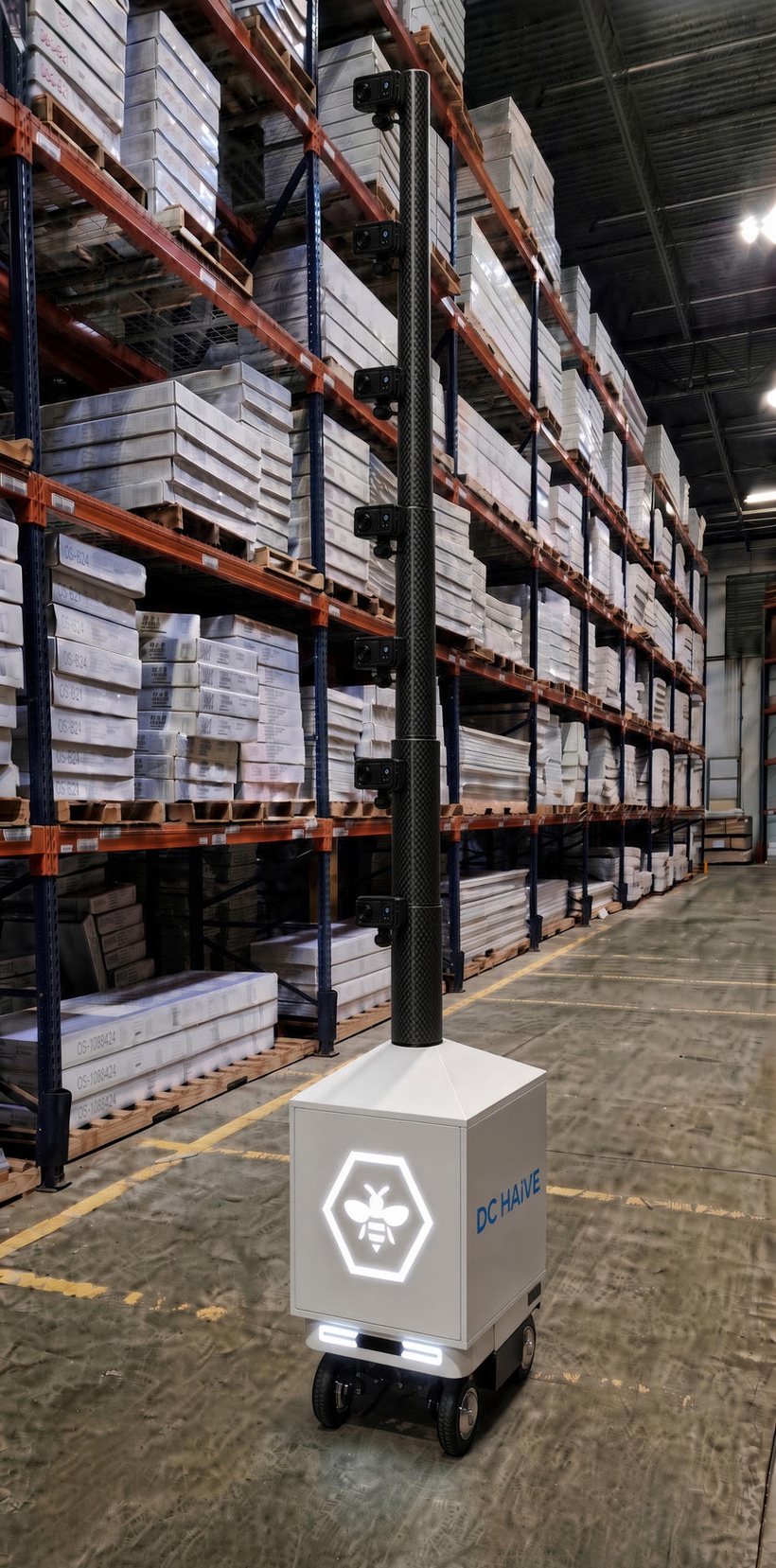
The DC HAiVE rover parked in a distribution center aisle beside loaded pallet racking. A rigid carbon-fiber mast rises from the vehicle body carrying seven camera positions, each aimed at the rack face.
Seven camera positions up a rigid carbon-fiber mast · every rack level captured in a single stationary exposure · the mast folds down for service and transport

The rover

A ground vehicle, built from parts you can service.

A production four-wheel-steer chassis carrying a rigid carbon-fiber mast, an 8MP HDR camera array, its own lighting, and enough compute to run the full inference pipeline onboard for a complete shift.

The hardware is modular and accessible at floor level. Maintenance does not require an aerospace vendor or work at height — it is within reach of your internal mechanical and IT staff.

ChassisFour-wheel steer, production
ComputeJetson-class edge module
Cameras8MP HDR array
MastRigid carbon fiber, folding
LightingDedicated onboard industrial
NavigationVision only
SafetyVision + hardware E-stops
RuntimeNear a full shift, one charge
ChargingStandard outlet, floor level
CaptureAll levels, simultaneous
UplinkLightweight JSON only

Configuration is fitted to the facility — rack height, aisle width and lens selection are set during implementation.

Why a ground vehicle

The requirement is to look at a rack, not to fly.

Existing attempts at automated inventory counting rely on aerial platforms. The approach is technically viable and substantially over-engineered for the task — which is a large part of why broad adoption has not followed.

Payload

Compute and optics have a weight budget

Running the full detection and recognition pipeline on the vehicle needs power and payload an airborne platform does not have. On a ground chassis it is readily accommodated — which is what lets the rover carry proper optics, dedicated lighting and enough battery to run close to a full shift on a single charge — against the fifteen-to-thirty-minute window the physics of flight allow.

Network

Nothing streams raw video across your Wi-Fi

A platform that cannot compute locally must send the video somewhere, which puts heavy traffic on a facility network that was provisioned for scanners and terminals. Inference at the edge means the only thing leaving the rover is a small JSON payload.

Risk

No airspace, no new class of liability

Overhead operation introduces collision, fall and sprinkler-interference risk, and the observers and restricted zones that come with managing it. A ground vehicle navigating on vision, with hardware E-stops, moves among floor traffic the way your existing equipment already does.

Adoption

Quiet, predictable, and unremarkable on the floor

Propeller noise and unpredictable overhead movement startle personnel and can mask audible safety alarms. The rover operates quietly at ground level and reads as standard warehouse equipment — which matters more for adoption than any specification does.

Full side-by-side comparison

The variance queue

An exception arrives with its own evidence.

The expensive part of a variance has never been finding it. It is the walk, the second count, and the argument about which number was right. DC HAiVE attaches the frame that produced the observation, so the review happens at a desk and the correction goes to the WMS on approval.

Variance queue · Run plan NIGHT-A Live
L3
B02-07-L336 / 36
B02-08-L3LPN mismatch
B02-09-L348 / 48
B02-10-L3empty
L2
B02-07-L260 / 60
B02-08-L248 / 48
B02-09-L2Qty 52 / 60
B02-10-L224 / 24
L1
B02-07-L172 / 72
B02-08-L172 / 72
B02-09-L154 / 54
B02-10-L172 / 72

10 of 12 positions closed without review · 2 exceptions raised with frame evidence · approved corrections post to the WMS

Getting to live

What implementation actually involves.

Deployment is a project, not a delivery. Here is the sequence, so you can judge the commitment before you agree to it.

01

Facility walkthrough and initiation survey

We walk the general flow and the inventory control operation, then collect the operational, financial and architectural data about the facility that feeds both the ROI model and the eventual configuration.

02

ROI model and current-state KPIs

We populate the model from your own numbers — inventory control cost, headcount, physical count scope, shortage rate — and capture the current-state KPI reporting the deployment will later be measured against.

03

Image collection and model retraining

We collect imagery from your distribution center and retrain the object detection networks on it. This is what makes the model yours rather than generic, and it is included in the engagement.

04

Rover buildout and WMS integration

Camera and lens selection, autonomous navigation development for your aisle geometry, and the design and build of the integration to your system of record.

05

Configure, test, train, deploy

Facility map and run plans configured, business rules set, the system tested against live inventory, your team trained on the variance workflow, and the rover placed into supervised service.

06

Support, evaluate, iterate

Post-deployment KPI measurement against the current-state baseline, ongoing support, and continued model retraining as your inventory and packaging change.

Measuring success

Agree the scoreboard before the rover arrives.

We capture your current inventory control and direct labor KPIs up front, then measure the same set after implementation. No new metric gets introduced afterward to make the result look better than it is.

Cycle counts executedVolume
Variance rateAccuracy
Cycle count execution timeLabor
Pick / replen shortage rateService
Inventory control headcountCost
Direct labor headcountCapacity

Where the product actually is

DC HAiVE is in pilot, and we would rather you hear that from us.

The complete ecosystem — inference engine, rover and platform — is built and has read live inventory inside operating distribution centers. It is also still maturing. Early customers should expect gaps and ongoing development, and will have real influence over what gets built next.

If you want a finished product with a decade of releases behind it, we are not it yet. If you want a say in how this works in a facility like yours, that is exactly what a pilot engagement is for.

Next step

See it against your own rack profile.

Send us your square footage, rack configuration, aisle count and WMS. We will walk you through what deployment looks like in your facility and where the return actually lands.