Rivendell Engineering

Automated inventory control

Inventory control that drives itself.

DC HAiVE is a plug-and-play rover powered by a custom AI inventory inference engine and a supporting web platform. It runs your aisles, reads every rack level, books clean counts to your WMS, and escalates only genuine discrepancies — while the people who used to count are redeployed to the work that fills orders.

Autonomous rover On-vehicle inference WMS integration

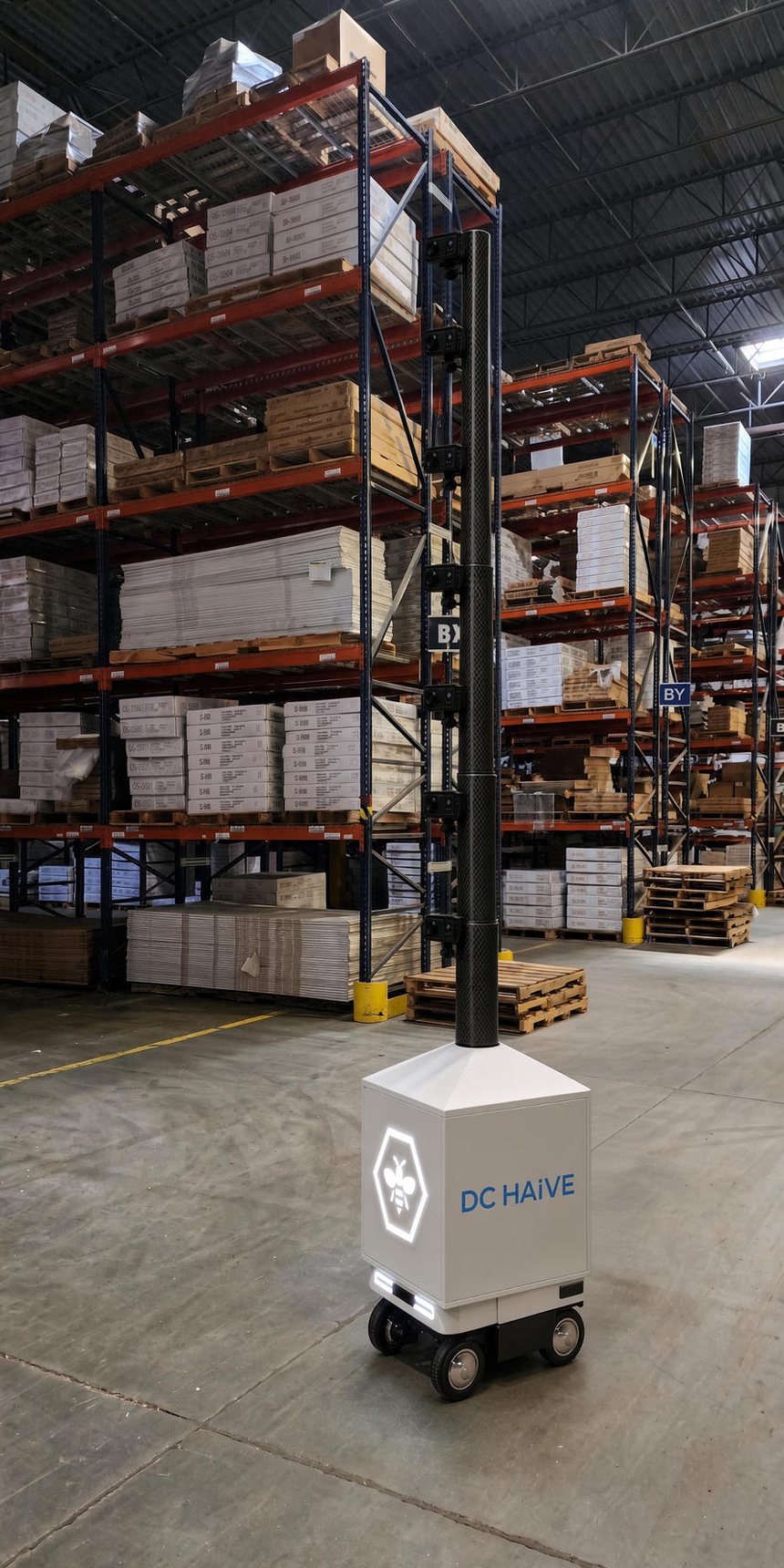
The DC HAiVE rover standing in a distribution center aisle — a compact white four-wheeled ground vehicle, roughly waist height, carrying a slim carbon-fiber mast that rises past the top rack level.
DC HAiVE in a standard aisle. The mast clears the top rack level from a vehicle that occupies about the footprint of a pallet jack.

The machine

Ground level, standard aisle, nothing changed in your building.

It is roughly the footprint of a pallet jack. It charges from a wall outlet, navigates the aisles your forklifts already use, and carries every camera it needs on a mast that folds down for service. No nests, no charging pads, no rack modification, no electrical work — which is why it can be delivered, configured and driving your aisles the same day.

MastCameras for every rack level
Cameras8MP HDR, own lighting
ComputeJetson-class, on-vehicle
RuntimeNear a full shift per charge
ChargingStandard outlet
Full hardware detail

The problem

Inventory control is a department that never ships an order.

A large facility staffs cycle counting across two shifts, budgets it every year, and gets a figure back instead of a shipment. It is necessary work. It has never been work that earns anything.

The cost

A permanent line item with no revenue attached

Dedicated counters, the forklifts and cherry pickers they occupy, the research hours spent chasing a variance across the floor, and the annual shutdown for a full physical count. All of it recurring, all of it budgeted in perpetuity.

The change

The same payroll becomes productive capacity

DC HAiVE reduces or eliminates the department. The headcount is redeployed to picking, packing and shipping — direct, value-added labor — while inventory accuracy is maintained or improved. The cost reduction and the throughput gain come from the same change.

DC HAiVE

Distribution Center Hub for AI Integrated Vehicles and Equipment.

An AI-powered camera array on an autonomous mobile robot, an inference engine trained on your racking, and the web platform that ties both to your system of record. Three components, built and operating as one system.

In pilot at live distribution centers

The robot

A rover that needs nothing from your building

Delivered, configured to the facility and placed into service. No nests, no charging infrastructure, no rack modification and no electrical work. It charges from a standard outlet and operates at floor level, alongside the traffic that is already there.

  • Four-wheel-steer chassis, vision-only navigation, hardware E-stops
  • Rigid carbon-fiber mast carrying an 8MP HDR camera array
  • Dedicated onboard illumination — results do not depend on facility lighting
  • Close to a full shift of runtime on a single charge

The AI

A custom inference engine, running on the vehicle

A Jetson-class module executes the complete detection and character-recognition pipeline onboard. Nothing streams raw video across your network — only lightweight results leave the rover.

  • Detection network trained on independently annotated warehouse data
  • Resolves location, LPN and quantity with a confidence score per read
  • A single model generalizes across facilities of no visual similarity
  • Retraining on your imagery is included, not a change order

The platform

The connective layer between rover and WMS

A multi-tenant web application that configures the facility map and run plans directing the rover, receives inference results, presents variances for review, and routes verified counts onward.

  • Facility mapping and run-plan configuration
  • Variance queue with the captured frame attached as evidence
  • Business rules decide what books automatically and what escalates
  • Real-time cycle count results delivered to your WMS by API

How it works

From configured run plan to booked cycle count, without human intervention.

01 Drive

Navigates a facility map you configure

The rover runs a defined plan built to meet your inventory control requirements, moving autonomously through standard aisles. No new infrastructure is required to support it.

02 See

Stops, stares, and reads every level at once

At each bay the rover pauses and the camera array captures all rack levels simultaneously under its own lighting. Detection and recognition execute on the vehicle; only lightweight data is transmitted.

03 Decide

Books what is clean, escalates what is not

The platform applies your business rules, posts validated counts to the WMS, and routes only true variances to your team — with the frame attached. Escalation by exception, not by volume.

Full platform detail

Where it stands

Built, integrated, and reading live inventory.

Not a prototype of a single component. The inference engine, the rover and the platform exist together, and the full loop — capture, inference, WMS posting and variance review — has been tested against real inventory inside operating distribution centers.

The AI

Reading live inventory, not test fixtures

The inference engine has been validated against real inventory inside operating distribution centers — deep stacks, mixed pallet types and case locations, under working conditions rather than a staged aisle.

The robot

Navigating a customer floor

The rover navigates aisles autonomously under supervision on a live distribution center floor, with its navigation camera array validated against a full check suite before it entered service.

The platform

Closing the loop to the WMS

Capture, inference, WMS posting and variance review have been exercised end to end. The connective layer is not a diagram — it is running.

Accuracy improves with each training iteration on facility-specific imagery. We will share current measured results, and the conditions they were taken under, once we are under NDA.

Ground, not air

Every funded competitor flies. That is the wrong answer.

Aerial platforms are technically viable and substantially over-engineered for this task. The requirement is to look at a rack — a problem the floor solves better than the airspace does.

Dimension
Aerial platform
DC HAiVE rover
Infrastructure
Nests, charging pads, electrical work and rack modification are prerequisites.
Operates at floor level and charges from a standard outlet. Zero vertical modification.
Duty cycle
The physics of flight cap operation at 15–30 minutes before recharge.
A heavy-duty battery payload on a ground chassis runs close to a full shift on one charge.
Compute
Payload limits preclude onboard inference, so raw video streams over facility Wi-Fi.
Inference runs on the vehicle. Only lightweight JSON leaves the rover.
Safety
Overhead collision, fall and sprinkler-interference risk, plus a new class of liability.
Vision-based navigation and hardware E-stops at ground level. No airspace hazard.
Operations
Pilots, visual observers, restricted airspace and suspended work nearby.
Navigates standard aisles autonomously. Surrounding work continues.
Image quality
Weight limits constrain optics and preclude dedicated lighting; motion blur is common.
A rigid mast holds 8MP HDR cameras steady and brings its own illumination.
Maintenance
Specialist aerospace vendors, or work at height.
Modular hardware serviced at floor level by internal staff.
Noise
Propeller whine and unpredictable overhead movement can mask audible safety alarms.
Quiet and predictable — it reads as standard warehouse equipment.

An order of magnitude simpler, more reliable and more elegant — because the design is proportionate to the problem.

Business value

Two pillars, and they compound.

Automating the bulk of cycle counting drives cost out of inventory control and drives productivity into direct labor. Because the rover assumes the counting workload from the day it enters service, both begin at once.

Pillar 01

Cost savings

  • Reduced inventory control headcount Eliminate the dedicated labor whose entire output is a count, while accuracy is maintained or improved.
  • Reduced inventory control equipment The forklifts and cherry pickers tied up by counting go back to moving freight.
  • Fewer research hours Variances arrive with evidence attached, so review happens at a desk instead of on a floor walk.
  • Physical counts reduced or eliminated Perpetual accuracy in the background removes the case for a disruptive annual shutdown.

Pillar 02

Productivity increase

  • Headcount shifts to direct labor Former inventory control personnel move into picking, packing and shipping — work that generates revenue.
  • Throughput follows capacity Newly available direct labor feeds straight into the facility's distribution flow.
  • Higher inventory accuracy Continuous, high-accuracy positions reveal the patterns a periodic count cannot.
  • Fewer picking shorts Catching discrepancies early reduces short frequency and the recovery cost that trails it.

Integration

It has to land in your system of record.

A count nobody trusts is not a count. DC HAiVE reconciles against the WMS and writes back through a documented API — validated counts close themselves, and exceptions arrive with the frame that produced them.

Talk to us about your WMS
POST /v1/cycle-counts application/json
{
  "location":     "A14-03-L2",
  "lpn":          "00000000000123456",
  "sku":          "RVD-44120",
  "observed_qty": 40,
  "wms_qty":      48,
  "status":       "variance",
  "confidence":   0.981,
  "captured_at":  "2026-09-09T14:22:07Z",
  "source": {
    "rover":      "ROV-01",
    "run_plan":   "NIGHT-A",
    "evidence":   "frame_88213.jpg"
  }
}

→ 202 Accepted   exception queued for review
→ 14 sibling locations closed validated

Illustrative payload. Field mapping is fitted to your WMS during implementation.

The firm

We build machines, and we help you choose the ones you buy.

DC HAiVE is our flagship, not our only work. Rivendell Engineering takes on robotics and mechanical design for other operations — and sits on your side of the table when you are evaluating someone else's.

Robotics

Robotics design & development

Your robotics design partner, from concept and architecture to a machine that runs on a real floor — autonomous navigation, sensor integration, perception on edge compute, and the software that ties it together.

Mechanical

Mechanical design & rapid prototyping

CAD design, design for additive manufacture, and functional prototypes you can put on a machine. Mounts, enclosures, masts and fixtures — designed, printed, tested and revised in short loops.

Advisory

Software & robotics selection

Unbiased requirements definition and RFP management across software and robotics vendors alike — reading their specifications the way someone who has built an autonomous machine reads them.

Implementation

WMS implementation

Design, configure, test, deploy. Full-lifecycle management from the operational blueprint to go-live, drawing on sixteen years of tier-1 WMS implementation experience.

Service detail

Next step

Tell us what your floor looks like.

Send us your square footage, rack profile, aisle count and the WMS you run on. We will come back with a straight read on whether DC HAiVE fits, and what it would take to put a rover on your floor.